
FAQ
GENERAL QUESTIONS
What is Masonry?
A: Masonry, aka brick and stonework, is one of the oldest surviving crafts in the world.
In fact, many of the world’s wonders are masonry creations, including the Egyptian Pyramids, Roman Coliseum, Taj Mahal, and Great Wall of China, and are admired for their outstanding architectural achievements.
Today, everywhere you turn, lays the work of skilled mason–in homes, schools, churches, hospitals, and more. Since its inception, architects and builders have chosen masonry for its beauty, versatility, and resistance against the destructive forces of time and weather. Masons take pride in knowing that their creations will be enjoyed for centuries to come.
As a Mason, What Would I Do?
A: Masons (aka bricklayers) work with brick, concrete block, glass block, tile, terra cotta and stone. Work can be as simple as building a wall or as complex as installing an ornate exterior or constructing a skyscraper. No matter what the job, the skill and precision required by a mason has yet to be replaced by machines.
As with many construction trades, masonry work is primarily performed outdoors. Masons work in all weather conditions, where buildings are enclosed with protective sheeting during cold months. This allows masons to work year‐round, which provides stability in their income.
The work is very physical, involving the use of hand tools, power tools and material handling equipment. Every brick and block must be laid by hand and requires the skill of a craftsman ‐ a true artisan. A skilled mason knows the different patterns, textures and colours that create an attractive finished product.
Masons must also be able to read blueprints, understand building codes and be knowledgeable of industry safety guidelines and rules for handling hazardous materials.
Will a Masonry Career Sustain Me?
A: YES!
In general, the construction industry is very busy, but masons are in high demand.
Current shortages along with an aging workforce across Canada are fueling the demand for new apprentices to replace and add to the number of skilled masons in Canada.
The increasing popularity of masonry units will stimulate demand for brick & stone masons. The diversification of your masonry skills accumulated with career experience and knowledge will help to ensure continuity of employment.
What Opportunities Can a Masonry Career Lead To?
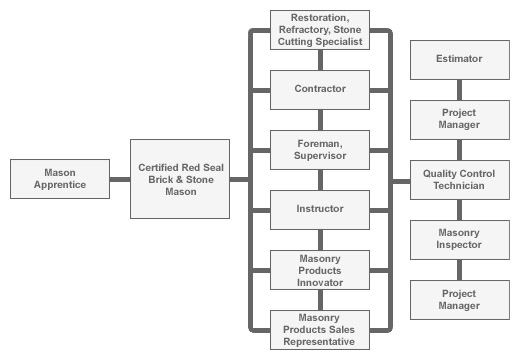
A: Some masons are specializing in very specific skills such as refractory and restoration work. Along with providing skills for the job, a background in masonry can lead to positions such as site supervisors, estimators, self‐employed contractors, and many other opportunities throughout your career.
What Do I Need to Succeed in a Masonry Career?
A: This work is often physically demanding and requires healthy individuals with good stamina. Masons need to have good vision, spatial perception, hand‐eye coordination and an ability to estimate size and dimensions.
Because masons often work on scaffolds, they must also be comfortable with working at heights.
Artistic skills are also a strong asset.
You must be at least 16 years of age. Must have Grade 8 education or higher (from Canada).
Apprentices must be able to work well, both individually and in teams under direct supervision.
Are Women Suitable for a Career in Masonry?
A: YES!
Although masons in the past have primarily consisted of men, many women have pursued their interest in masonry and enrolled in our school and even instruct courses.
Women do need to be able to perform the physical duties associated with a masonry career, but gender should not deter them from pursuing this career path.
Do I Have to Join the Union?
A: NO!
Access to training is available to everyone in the masonry industry regardless of membership in an organized union.
If you choose to work for a unionized mason contractor, you can sign up with the local bricklayers’ union office.
Is This Program Available at Other Colleges or Training Institutions?
A: Currently, OMTC has two campuses, our main campus in Mississauga and one in Ottawa (Orleans)
The colleges we have partnered with are Conestoga College in Waterloo, La Cité Collegiale in Orleans and St. Clair College in Windsor.
Elsewhere in Ontario, we are aware of Ministry-approved programs offered by LiUNA Local 183 in Vaughan, Cobourg and Barrie, Fanshawe College in London and St. Lawrence College in Kingston.
Although each of these institutions teach according to a common government standard for Brick & Stone Masonry, the programs will vary in content and quality.
Do I Need to Attend School First?
A: YES and NO.
Yes, if you have little to no experience and have difficulties finding a masonry employer to hire you as an apprentice, we suggest starting in programs like Pre-Apprenticeship and Construction Techniques.
No, if you are already working in the masonry trade, we suggest getting Registered as an Apprentice to start the Apprenticeship Program, when your employer decides you are ready for school, then they will lay you off to start Level 1.
APPRENTICESHIP QUESTIONS
What If I Don't Have a Skilled Worker (Employer) Willing to Take Me On as Their Apprentice?
A: Regardless of the demand for new masons, it can take a lot of hard work and determination to locate an employer who will give an inexperienced individual an opportunity.
Typical of the construction industry, most jobs are found through networking (word‐of‐mouth) and job site visits, but some positions are posted on websites such as www.jobbank.gc.ca and https://www.apprenticesearch.com
Many individuals also find opportunities by beginning as a mason tender (or bricklayer’s helper) although any construction exposure will give you an advantage in finding a full‐time employer.
Beginner programs such Pre‐Apprenticeship and Construction Techniques may also help strengthen your resume to make you more desirable to employers.
Don’t get discouraged too quickly if an opportunity doesn’t emerge right away; the benefits will far outweigh the footwork once you gain some hands‐on knowledge of the industry!
How Much Will I Earn?
A: Wage rates vary depending on the employer, the sector (industrial, commercial, institutional [ICI] or residential), the type of work and whether the contractor is union or non‐union.
OYAP, Construction Techniques and Pre‐Apprenticeship Work Placements are usually minimum wage.
For the Apprenticeship Program:
When your masonry employer or sponsor Registers you as an Apprentice with the Ministry of Training, Colleges and Universities, the “Training Agreement” legislation states that you will be paid a minimum of 40% of an employer’s average journeyman wage to start, with the percentage increasing to 60%, 70% and 80% for every 1400 hours worked.
When your masonry employer or sponsor Registers you as an Apprentice with the Ministry of Training, Colleges and Universities, the “Training Agreement” legislation states that you will be paid a minimum of 40% of an employer’s average journeyman wage to start, with the percentage increasing to 60%, 70% and 80% for every 1400 hours worked.
For example, if the average hourly wage in the company for a journeyman is $40, you will receive 40% of that figure.
How Do I Sign Up for My In-School Portion of Training?
A: Registered Apprentices will receive an “Offer of Classroom Training” from your preferred schooling, for example our school!
If you do not receive an “Offer of Classroom Training”, please notify the ministry right away to make sure that you have been placed under your preferred schooling list and that your email address is up to date.
When Does In-School Training Run?
A: OMTC is aware of how busy jobsites can get during the summer months, therefore we make every effort to schedule in‐school training in the “slower” construction season which is between September ‐ May.
There are three in‐school levels for the Brick and Stone Masonry trade – Basic, Intermediate and Advanced.
Each level is 2 months (8 weeks).
The hours are Monday to Thursday, 7:00am ‐ 4:00pm and Fridays, 7:00am ‐ 1:30 pm.
This will give a 40‐hour week like that found in the construction industry.
How Much Does the In-School Training Cost?
A: The Ministry of Labour, Training and Skills Development, Ontario Masonry Contractors’ Association (OMCA), Canadian Concrete Masonry Producers Association (CCMPA), Cement Association of Canada (CAC) and Brampton Brick fund most costs associated with training apprentices at OMTC.
Apprentices are required to share in these costs by paying the $400 classroom fee per in‐school level.
First time applicants will also have to purchase the mandatory textbook which cost $95 tax included.
Apprentices need to bring their own tools for each level.
An optional $400 interest‐free tool loan by the Ministry of Labour, Training and Skills Development can help fund tool purchases.
OMTC will supply lesson notes, building materials, and use of power tools for classroom and hands‐on training, not to mention our terrific instructors!
How Do I Financially Support Myself and/or Family While I'm in Class For the 2 Months?
A: If eligible, an Apprentice can collect Employment Insurance (EI) while in school.
Contact or Visit Service Canada if you are not sure of your eligibility requirements.
Canada Apprentice Loan is also available for apprentices who need to borrow money during their time in school.
If eligible, a ministry representative will come in the first or second week of class to discuss any financial assistance such as travel allowances, living‐away expenses, day care expenses, etc.
Registered Apprentices may also be eligible for government grants such as Apprentice Incentive Grant and Apprentice Completion Grant – Google their website get more information!
How Can I Learn More About the Apprenticeship in Ontario?
A: You can visit the Government of Ontario website, https://www.ontario.ca/page/apprenticeship-ontario
How Can I Find More Information About Masonry Training?
A: You may email us at registrar@canadamasonrycentre.com
For more information, drop us a line.
OMTC is an accredited Training Delivery Agent (TDA) for Ontario that provides quality training for the brick and stone masonry trade through programs such as pre-apprenticeship and apprenticeship